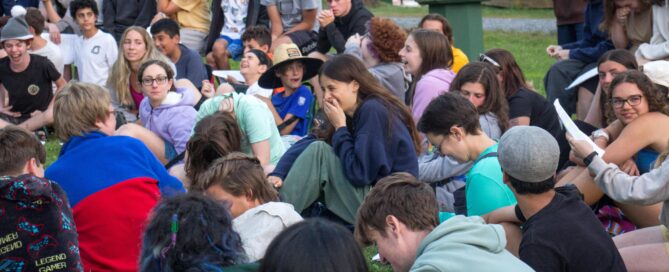
We can’t believe how quickly time has passed since the end of the summer. Here in Philadelphia, the trees are starting to change colors and we’re pulling out our cold weather jackets. The change of season allows us to think back on what was truly an amazing summer at camp. We are so glad to have you in our camp community, and so proud of everything that you accomplished this past summer. Here is a reminder of just a few of the accomplishments and growth that you achieved while at Akeela …
You made your bed and helped clean your bunk every day!
You chipped in with “dining hall duty” to help meals run smoothly.
You participated in meal-time discussions with your bunkmates and counselors.
You joined in all kinds of activities, even new ones that made you uncomfortable.
You considered the feelings & needs of the rest of the community.
You survived – and thrived – without electronics or internet access for more than three weeks!
You made connections with campers outside your bunk by sharing common interests.
You made an announcement or were recognized at an Evening Meeting.
You went on multiple hikes.
You left the comfort of your home and your family to be at Akeela.
As you look at that list, we’re sure that it brings back many other memories of your time at Akeela. No doubt you’re thinking of your camp friends and we know that they’re thinking about you, too! We hope you take this opportunity to reach out to them. Send them an email or message today! Maybe tell them about how school is going, what activities you’re doing outside for fun, or what you’re dressing up as for Halloween.
We can’t wait for next summer and are thrilled about how many of you will be with us again then. As the school year moves on, we’ll be sharing lots more information and updates about Akeela 2025. In the meantime, enjoy the rest of the fall!
With love,
— Debbie, Eric and Erin
Also in this newsletter:
Updates from your camp friends
Eric’s favorite Pumpkin Cookie Recipe
Gen Alpha wordsearch
Debbie’s blog about the benefits of “breaking up” with your phone
After another summer at camp where I am able to completely unplug from social media and the news and the mindless scrolling that comes along with both of those things, I realized that my camp relationship with my phone was much healthier than my home relationship! So I decided to seek help from our local library and I recently finished reading “How to Break Up with Your Phone” by Catherine Price! It’s not your average self-help book—it’s a practical, science-backed guide on how to reclaim control over our devices and, ultimately, our lives.
The Phone “Problem”
The core issue, as Price describes it, isn’t that phones are bad—it’s that we’ve developed an unhealthy attachment to them. This stems from their design: social media platforms, notifications, and even the apps we use daily are built to capture and maintain our attention for as long as possible. In the process, they change how we think, what we pay attention to, and even how we interact with the world around us.
As I read through the first chapters, I found myself thinking about my habits—checking my phone right after waking up, constantly reaching for it in idle moments, even using it as an escape from boredom. Sound familiar?
The 30-Day Plan
What really sets this book apart is the actionable plan Price outlines: a 30-day “phone breakup.” This isn’t about throwing your phone out the window or going on a digital detox for good. It’s about creating space between you and your device, so you can have a healthier, more intentional relationship with it. I’ll admit, some of it was pretty obvious and some was a bit “cheesy”, but it was still helpful to see it all laid out for me in print!
The Benefits of Breaking Up
One of the most powerful takeaways from the book is that, in breaking up with your phone, you gain so much more than just extra time. Price points out the ways in which phone overuse impacts our memory, creativity, and mental health. By reducing screen time, we not only free up space for more meaningful activities but also allow ourselves to be present in our own lives.
This reminds me of the experiences shared by children who attend screen-free summer camps like Camp Akeela. These camps, where kids spend days or weeks entirely free from phones and other devices, provide living proof of the benefits of stepping away from screens. At Camp Akeela, campers report feeling more connected to nature, making deeper friendships, and rediscovering hobbies and interests they might not otherwise have explored. It’s a clear example of how stepping back from technology fosters creativity, enhances social connections, and brings a sense of calm and focus that’s hard to find when we’re constantly plugged in.
For example, instead of mindlessly scrolling through Instagram during downtime, I started using those moments to read more, reflect, or just be still. The result? I feel more focused and less frazzled. I’ve also noticed I’m more engaged in conversations and less distracted during family time—something I didn’t realize I was missing out on.
Practical Tips that Worked for Me
**Turn off unnecessary notifications**: I used to get notified for every email, message, and app update. Turning off all but the essentials has drastically reduced the number of times I instinctively check my phone.
**Establish phone-free times and places**: Keeping my phone out of the bedroom has helped me sleep better. I also started leaving my phone in another room during meals, which made me more present during family time.
**Use apps to track and limit phone use**: Price encourages readers to download apps that monitor phone usage. Seeing those stats was a reality check. I set daily limits on my social media usage, which has been a game-changer.
**Replace idle phone use with something intentional**: Instead of reaching for my phone when I’m bored, I now carry a book with me or take a moment to daydream. It’s amazing how much we rely on our phones to fill every empty second.
Final Thoughts
I want to be more present in my life for my family and friends but also because I realize that I’m missing out on so many of the little things when I’m looking at my phone. Because of camp, I know what it feels like to be screen-free (it’s more like “screen-limited”). It’s such a gift to have almost 3 months away from technology and even more so for our children who seem to be even more entrenched in their digital life than we are. On top of that, we also know that folks who are Neurodivergent are even more likely to be reliant on technology and having a break allows them to reset expectations around screen time. 18 years ago, when we started Akeela and decided not to have any technology, I don’t think we really understood how important that would be for our campers, but it turns out it might be one of the top 5 most beneficial outcomes of a summer at camp.
Last spring, I was contacted by the producer of Dan Heath’s excellent podcast, “What It’s Like To Be …” Dan and his brother, Chip, are the authors of four New York Times bestselling business books: Decisive, Switch, Made to Stick and The Power of Moments. Dan is a senior fellow at Duke University’s CASE Center, which supports social entrepreneurs. His “What It’s Like To Be …” podcast explores a variety of professions through interviews with people who love what they do. Dan describes the podcast this way: “If you’ve ever met someone whose work you were curious about, and you had 100 nosy questions but were too polite to ask … well, this is the show for you.”
I was thrilled that they reached out to me when they were thinking of making an episode about being a camp director. My experience has been that very few people understand exactly what camp directors do (especially between September and May!), so this was a great chance to shed some light on that topic. And, of course, I always love talking about camp, so I knew the interview would be great fun!
After a wide-ranging phone conversation with show’s producer, I was told that they’d get back to me. Until then, I didn’t fully realize that the phone call was a pre-interview audition! But I felt good about it and, indeed, five days later I got an email indicating that they wanted to move forward with a taped interview with Dan Heath for the podcast. Other than a quick mic check and a preview of their standard “lightning round” questions that they ask at the end of every interview, there was no advanced preparation for the interview; I was just told to expect a casual conversation about my job. Again, not intimidating from my perspective – I will happily talk about camp for hours and hours to anyone who will listen!
Not a minute into the interview with Dan, I knew that I was in great hands. He was an incredibly genuine, inquisitive, kind and well-prepared host. I could tell that he had a firm grasp on the show’s steering wheel, so to speak, but that he was flexible enough to allow the conversation to meander to its natural destinations. When the show was released in August, I was quite proud of how it turned out. We touched on a variety of aspects of camp life, from the sublime to the ridiculous. Here are a few of my highlights:
How camp becomes a place where kids can reinvent themselves, and be the best versions of themselves
The unusual ways in which a camp director’s job differs between the summer months and the rest of the year
How we help young people navigate the transition from home to camp … and the transition from camp to home at the end of the summer
Why camp friendships (and, often for staff, romantic relationships) are different from those that form anywhere else in the world
How having cool, young counselors serving as “near-peer” role models creates unique growth opportunities for kids
Why working at camp is great preparation for any career
Why it’s important for camps to evolve, but also how camp traditions become reliable touchstones in a quickly changing world
How the separation from parents is part and parcel of the magic of camp … Like so much fiction and mythology for young people (books, movies, etc.), it sometimes takes the challenge of being on your own to discover what you’re truly capable of
I hope you’ll take a listen to the Summer Camp Director episode of “What It’s Like To Be …” podcast. It was released on August 13, 2024. Find it wherever you get your podcasts, or at the show’s website: https://www.whatitsliketobe.com/
One minute it was cold and snowing at Akeela, and the next minute everything was in bloom! Spring is finally here and we’re getting excited for the start of summer! Late April also means it’s time for the latest Camp Akeela newsletters:
Now that it’s March, the camp season is just around the corner, and our latest newsletter is all about how to start preparing for the summer! It also includes a brief introduction to this year’s head counselors.
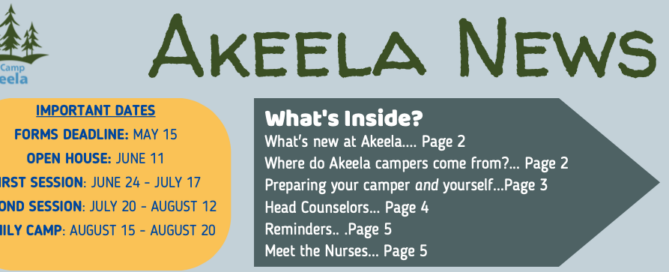
CAMP FORMS – All of our required camp forms are now ready for you, and are due on May 15th. Access them through the Staff & Family Log In Campanion App. (See below; the app is the easiest way to submit those forms that require scanning & uploading.) While some forms can certainly wait until later in the spring, others are best submitted as soon as possible: Text Opt-In Form, Open House RSVP and Transportation Form. Thank you!
DOWNLOAD CAMPANION – The best way to stay connected with your camper this summer is through the Campanion App, which is now available to all Akeela families, at no charge. We encourage you to download it and set up your account now. With Campanion’s facial recognition technology, you’ll get a personalized photo feed, along with push notifications for all news that applies to your child. It’s also a great way to submit your camp forms.
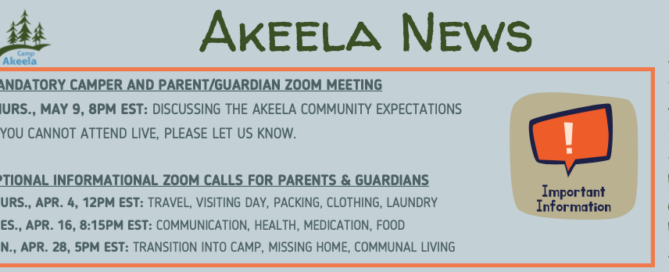
REQUIRED ZOOM 5/9 – We will be hosting a mandatory Zoom call for all Akeela parents and campers at 8pm Eastern Time on May 9th. It will be a quick meeting to discuss our community expectations. Please save the date.
FAMILY HANDBOOK – Please take the time to carefully read the Akeela Family Handbook … even if you’ve sent your child to Akeela in past summers! It is updated regularly and contains answers to all kinds of questions you may have about camp. On a related note, we will be hosting a few optional live Zooms in April. We will address many of the topics in the Family Handbook and your corresponding questions. See the newsletter for those topics.
REGISTER FOR CAMPMEDS – All campers taking daily medication of any kind (prescription or over-the-counter) must have those meds sent to camp via CampMeds. Registration for CampMeds is now open. NOTE FOR RETURNING CAMPERS: This is not the same company that we used last year. Be sure to register here.
BOOKING FLIGHTS TO CAMP – Please check with Eric before making any flight arrangements for your camper’s arrival on opening day of their camp session. To ensure an easy experience at the airport and a timely arrival at camp, we will often coordinate specific flight plans for our camp families.
CHANGE TO OUR RETURN TRAVEL OPTIONS – Due to the unpredictability of air travel, we are no longer able to accommodate campers flying home alone at the end of their camp session. Instead, any camper departing camp via air must be met at Boston Logan Airport by an adult who either flies home with them or takes responsibility for getting them to their departing flight.
ORDERING AN AKEELA T-SHIRT – It’s not too early to order your Akeela gear from The Camp Spot, as they get quite busy in the late spring. There is lots of great Akeela gear available but only the basic logo’d lightweight cotton t-shirt is required.
It’s widely understood that neurodivergent individuals, including those with autism, NLD or ADHD, often face unique challenges in navigating social interactions. It also goes without saying that a certain level of comfort with social skills is crucial for personal and professional success in today’s world. What seems to be less clear is how to best teach social skills to neurodivergent kids and teens.
Traditional methods of learning social skills often rely on neurotypical peer modeling, assuming that observing and imitating typical behavior will lead to successful social integration. When we started Camp Akeela in 2008, one of our foundational principles was that this concept of “modeling” in neurotypical environments had significant limitations.
Challenges with Neurotypical Peer Modeling
1. Lack of Relatability:
Neurodivergent individuals may struggle to relate to neurotypical peers due to fundamental differences in their cognitive processing. Neurotypical social behaviors and cues may be perplexing or overwhelming for neurodivergent individuals, making it challenging for them to internalize and apply these learned behaviors in real-life situations.
2. Non-Contextual Learning:
Neurotypical peer modeling often occurs in controlled environments, such as classrooms or therapy sessions, which may not mirror the complexities of real-world social situations. Neurodivergent individuals might struggle to generalize the learned behaviors to different settings, hindering their ability to adapt and apply social skills across diverse contexts.
3. Sensory Overload:
Many neurodivergent individuals experience sensory sensitivities that neurotypical individuals may not fully comprehend. Traditional peer modeling may not consider these sensory challenges, leading to difficulties in processing and implementing social skills effectively. Sensory overload can result in anxiety and withdrawal, hindering the learning process.
Neurodiverse Peer Modeling at Camp
The past 16 summers of leading Camp Akeela have only reinforced our belief that an immersive and specialized environment like camp can be a vehicle for more effective social skills development. Indeed, because Akeela is a community that is, specifically and intentionally, designed for our neurodivergent campers – and ALL of our campers fit that description – it is the perfect environment in which to pursue alternative approaches that lead to meaningful social growth.
Alternative Approaches That Work for Neurodivergent Children
1. Contextual Learning:
Instead of focusing solely on isolated skills in controlled environments, emphasizing contextual learning in natural, everyday settings can better prepare neurodivergent individuals for real-world social challenges. Interactive and immersive experiences allow for a more holistic understanding of social dynamics, promoting generalization and application of social skills, along with adaptability in various situations.
2. Neurodivergent Peers:
Providing neurodivergent individuals with peers who share similar neurodivergent profiles offers more relatable examples of successful social interactions. They are more motivated to build and maintain deep friendships when they share interests and experiences with others.
3. Individualized Social Skills Coaching:
Recognizing the unique strengths and challenges of each neurodivergent individual is crucial for effective social skills training. Tailoring interventions to address specific needs, such as sensory sensitivities or communication styles, ensures a more personalized and successful learning experience.
4. Near-Peer Role Models Who Are Trained As “Social Coaches”:
Summer camp counselors are in a unique position to have a positive impact on young people in their care. Because they’re typically 20 – 25 years old, they can relate to campers in a way that differs from parents and teachers. When they are carefully trained to provide social feedback and in-the-moment coaching, they can make a dramatic difference in their campers’ social skills.
While neurotypical peer modeling has been a prevalent method for teaching social skills, its limitations in catering to the unique needs of neurodivergent individuals cannot be ignored. Our campers benefit greatly from being surrounded by peers who experience the world in similar ways to them. They feel a sense of true belonging and acceptance, which allows them to be more open to receiving and implementing social feedback and coaching. When this happens in an environment that presents countless real-world challenges and scenarios, social skills don’t have to be “taught”. Instead, they are practiced in a way that breeds success and confidence, all of which help young people internalize and generalize those skills to other situations. Ultimately, this means more fulfilled and successful neurodivergent individuals — and a society that is lucky enough to benefit from their amazing and unique contributions!
Looking to learn more? We have a plethora of articles and resources for parents, and kids alike, to provide insights into the world of neurodiversity. Whether you are looking for book recommendations, life skill advice, or want to learn more about the importance of independence, check out our blog!
While we still haven’t gotten any “real” snow here in Philadelphia, up at camp, it’s a winter wonderland! It’s hard to believe that 2023 is over and that camp is less than six months away! We’ve been very busy talking to new families about Akeela and we find so much joy in sharing stories about our community and the amazing development of friendships we’ve witnessed since 2008!
We’re excited to welcome our new campers this summer and can’t wait to see them fall in love with Akeela as much as all of our returning campers have. We’re also meeting a lot of incredibly talented and passionate staff members who will be joining us from all over the US and the world! Our community has always been one of acceptance and that makes us feel extremely proud!
As the calendar turns to a new year, we want to tell you how grateful we are to you – our Akeela community. We feel so lucky to have an extended camp family with whom we can share the gifts of friendship, community, growth, pride and fun! We can’t wait to see you up at camp in 2024!
Love,
Eric, Debbie & Erin
Also in this edition of the newsletter:
Photos of some new Akeela swag & camp under lots of snow
Our advice for making the holiday season as smooth as it can be
Despite a very rainy first session, 2023 was an absolutely wonderful summer at Camp Akeela! It was filled with friendship, spirit, warmth, pride and fun. All of that comes from bringing together a community of incredibly kind campers who open themselves up to all of the wonders that camp has to offer.
As we look back on the summer, we feel so much gratitude for our staff. Speaking with our colleagues in the camp world always reminds us just how lucky we are to attract such a talented, passionate and dedicated set of counselors and staff members. 2023 brought a large group of first-time Akeela counselors and as we’ve following up with them throughout the fall, it’s striking to hear how much Akeela already means to them. They think about camp as they resume their college coursework or get back to their jobs, and many are planning to return for another summer in 2024!
Debbie, Eric and Erin are already busy in our Philadelphia office preparing for next summer. In addition to re-enrolling returning campers, we have a record number of new families inquiring about camp and we’re excited to share the Akeela experience with them!
Thank you to all of the parents/guardians and campers who completed our post-summer surveys. We’re always learning and growing, and are so grateful for your partnership in continuing to expand Akeela’s horizons!
We hope you enjoy this newsletter, in which you will find:
A reminder of 2024’s dates
Quotes from the post-camp survey responses
A fall recipe from Chef Trina
News about our most recent (and 14th) “Akeela baby”
These newsletters contain a lot of important and exciting information about this coming summer, including:
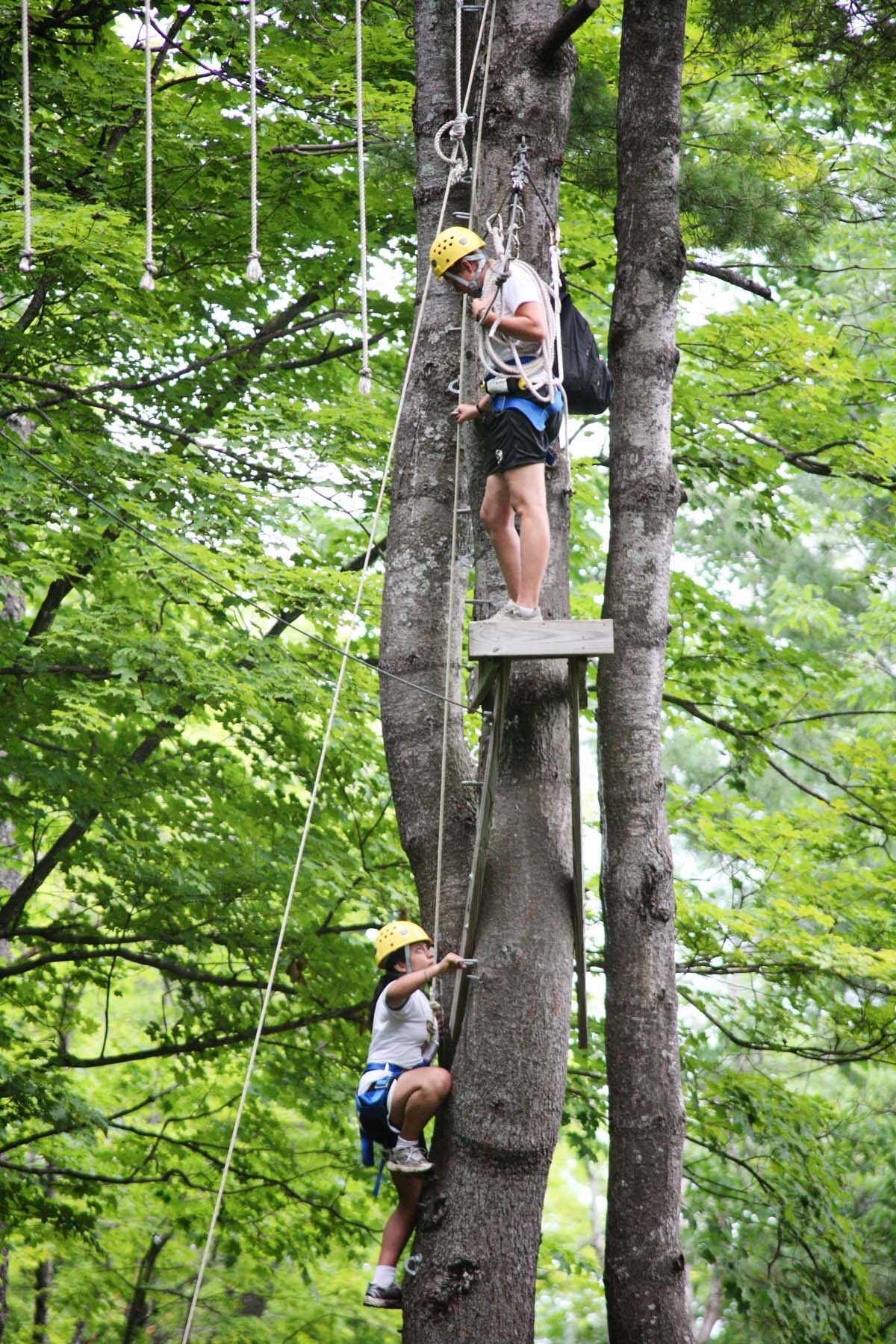
What’s New At Akeela This Summmer: new ropes course elements, an amazing inflatable in the lake and pickleball!
Where Campers Come From: a cool look at how many states (and countries) are represented by our 2023 campers.
Head Counselors: what is their role and camp and who are the 2023 head counselors?
Camp Nurses: Meet Pam and Chuck, our wonderful health care team
Camper To Do List: A few things campers can do between now and arrival to get ready for the best summer of their lives!
What To Expect On The First Day: A detailed breakdown of what that camp arrival day will be like
The parent newsletter also begins with the following thoughts from Debbie:
Both of our daughters (ages 14 and 9) will be away at their camp this summer for 7 weeks. I’m a camp director and we’re very friendly with the camp directors who run their camp. I “shouldn’t” be nervous, right? But I am! I am a worrier and I worry most about my family – so when I allow myself to get caught up in thinking about the “what-ifs”, it can get pretty messy and then my anxiety is obvious to my kids.
I know that my most important task right now is to help instill a sense of confidence in my children before they are at camp on their own. In order to do that I also need to prepare myself, and that takes time and energy – a positive energy. Pushing through our own fears and worries needs to be a priority so we can meet our children with a “clean slate”. They need to feel our optimism and confidence that going to camp will be a life-changing experience – one that will enable them to become more independent and confident, and will hopefully open them up to meaningful friendships that will last a long time. Our children are intuitive and if they sense that we’re afraid about this very big transition, they will take on that worry themselves.
Some things that I’ve found helpful, and some advice for those of you who are worried and anxious about camp this summer:
Write it down! Take some time during the day (not right before bed or you’ll never be able to fall asleep!) to jot down anything that’s making you feel anxious. Writing your worries down will allow you to acknowledge them and either use your notes to address the concern, or let it go.
This includes making lists – what do you need to do? Have you completed your forms? Sent in the RX from the pediatrician? Looked at the packing list to assess what you might need? And have you gone through last year’s “camp stuff” to see what still fits?
Call us! If you’re concerned about something, maybe we can help. Sometimes, more information is helpful in minimizing our fears.
Breathe! Go for a walk or take 10 minutes with a cup of tea to just relax. How often do you allow yourself to take time for just yourself? It’s important and it’s helpful.
Read “Homesick and Happy” by Michael Thompson. This is a great book, especially for first-time camp parents. It’s filled with helpful information, plus – reading will help you take your mind off of your own worries.
By the way, this is great advice for your anxious camper, too! Once you are feeling confident about having your camper with us at camp, take some time to sit down with them to make a list of their “things to do” before camp. Maybe there’s one task you can do together each week to prepare, for example: address envelopes for letters to family/friends, email Debbie/Eric/Erin a few questions, make a list of books/card games/crafts you want to bring to camp, etc.
You may also want to help your camper make a list or start a journal with things they’re looking forward to doing at camp. Do they have a goal in mind? Something new they want to try or something they want to accomplish? It’s also a great time to start pushing your camper to be more independent in anticipation of being on their own this summer. Are younger campers getting ready for bed and school independently? (Showering, brushing their teeth, putting away their clothes …) Are older campers thinking about non-electronic tasks they can do during down times this summer? Having your camper think about these things NOW will help them feel more prepared as summer approaches.
Finally, as I’ve written about this year on a few different occasions, it’s important to use language that acknowledges a child’s worries but also expresses confidence. Statements like, “I know you’re worried about going to camp AND I’m really certain that you can do this.” These types of statements are the loving push our campers need to feel more secure in this transition.
We’re very excited to see your child up at camp in a very short time – sooner if you’ll be joining us for our Open House in June! Your camper’s head counselor will be emailing you in mid-June to introduce themselves to you and they’ll want to know if there’s anything on your mind. Feel free to start a list now that you can email or call once our team is all up in Vermont. Enjoy your Spring and we’ll see you soon!
First, I finished reading one of the most insightful and helpful books I’ve read in a long time. It’s called, “The Coddling of the American Mind”. You’ve maybe heard of it, as the authors, Jonathan Haidt and Greg Lukianoff, have been discussing their thoughts on social media for a number of years now. The book was published in 2018 after their article in The Atlantic got a lot of attention a few years earlier. I read it because I was interested in hearing their thoughts about life on college campuses, both because we work with 100 college students every summer and because I’m raising two daughters who will one day be young adults themselves!
The second thing I did was take a 2-day training with Eli Liebowitz at the Yale Child Study Center. I wrote about his SPACE program in a previous blog and was so interested in his theory and process that I wanted to learn how to put it into practice myself. As a reminder, Dr. Leibowitz has created a way for clinicians to work with the PARENTS of kids who are anxious in an effort to help them teach their children that they have the ability to do hard things, that they can work through discomfort – without parents “accommodating” them by removing the stressors or coming to their aid. The idea is that we can help parents step back so that their children understand their own resilience. It’s powerful and it works!
Insights from “The Coddling of the American Mind” and the SPACE Program
So, what do these two accomplishments have in common, and what do they have to do with camp? Well, first, I love sharing resources with our Akeela community so I’d urge you to explore both the book and the SPACE program. Also, I’m excited to bring what I’ve learned to our campers and staff this summer. The biggest overlap for me is the idea that when things make us feel uncomfortable, we are not necessarily unsafe or in any real danger. There is what Haidt and Lukianoff call the “Great Untruth” of “safetyism” that is pervasive on college campuses and, I would argue, is also spreading out into the general public, including our middle and high schools. They suggest that many people now believe this: “What doesn’t kill me makes me weaker”….a (faulty) belief that we need to avoid all pain and any POTENTIAL struggle.
Another “untruth” from the book is “Always trust your feelings” without challenging or questioning them. The authors explain that there is an underlying sense that we need to act on our FEELINGS without pause. “Trusting your gut” is fine and serves a purpose, but both of these untruths also mean that a large number of people – and I’m most worried about our teens and young adults here – are missing out on GROWTH opportunities. Blindly following your feelings rather than questioning the thoughts and data that might accompany those emotions can be unwise and unhelpful. If we don’t face challenges or take a chance, we will never learn or stretch — and that is concerning. If we allow our child to sleep next to us every night because he is afraid of the dark, we are not giving him the chance to develop a belief in himself that he can be safe on his own. If we allow our child to eat by herself in the nurse’s office every day because she’s worried that someone will tease her in the cafeteria, we are validating her belief/thought that she can’t tolerate discomfort of something that hasn’t even happened yet … and thus might miss out on making a friend.
Encouraging Growth Through Discomfort at Camp
One of the suggestions at the end of “Coddling” is that parents should send their children to camp. Of course! Camp is where we challenge campers to stretch their comfort zones. Parents often ask me on our initial call about camp, “What do you recommend when a child doesn’t want to go to camp because he’s never done it before?” And I always say the same thing, “MOST children – especially children who struggle socially and with anxiety – do not want to do something new. It’s hard and it takes work … AND with guidance and managed expectations, most kids are able to push through that initial fear and are able to truly thrive at camp.” What a gift to be able to give to children: the ability to help them learn that they have what it takes to work through something uncomfortable, and to come out the other side of those feelings with a sense of accomplishment and pride, stronger and more resilient for the experience. It’s honestly the best part of what we do at camp.
Akeela’s Commitment to Helping Children Thrive at Camp
A few takeaways that we’ll be implementing at camp this summer:
We will continue to encourage our campers and staff to recognize the growth potential in doing things that make them uncomfortable: things they are scared to try, things that they think they may not be good at, things they’ve never done before — of course without ever compromising their physical or emotional safety.
We will use language like this, “I know you’re worried about trying this and I’m 100% confident that you have what it takes to do it.”
We will not “over-accommodate” campers or staff who are feeling anxious about something. Instead, we will explain how confident we are that they can do it and will give them space and support they need to succeed.
While none of this is really NEW to us at Akeela, it’s always nice to be reminded how important camp is. We believe that camp is one of the best ways to teach kids (and staff) the skills they need to become resilient. We can’t wait to get back to work this summer!






 Check out